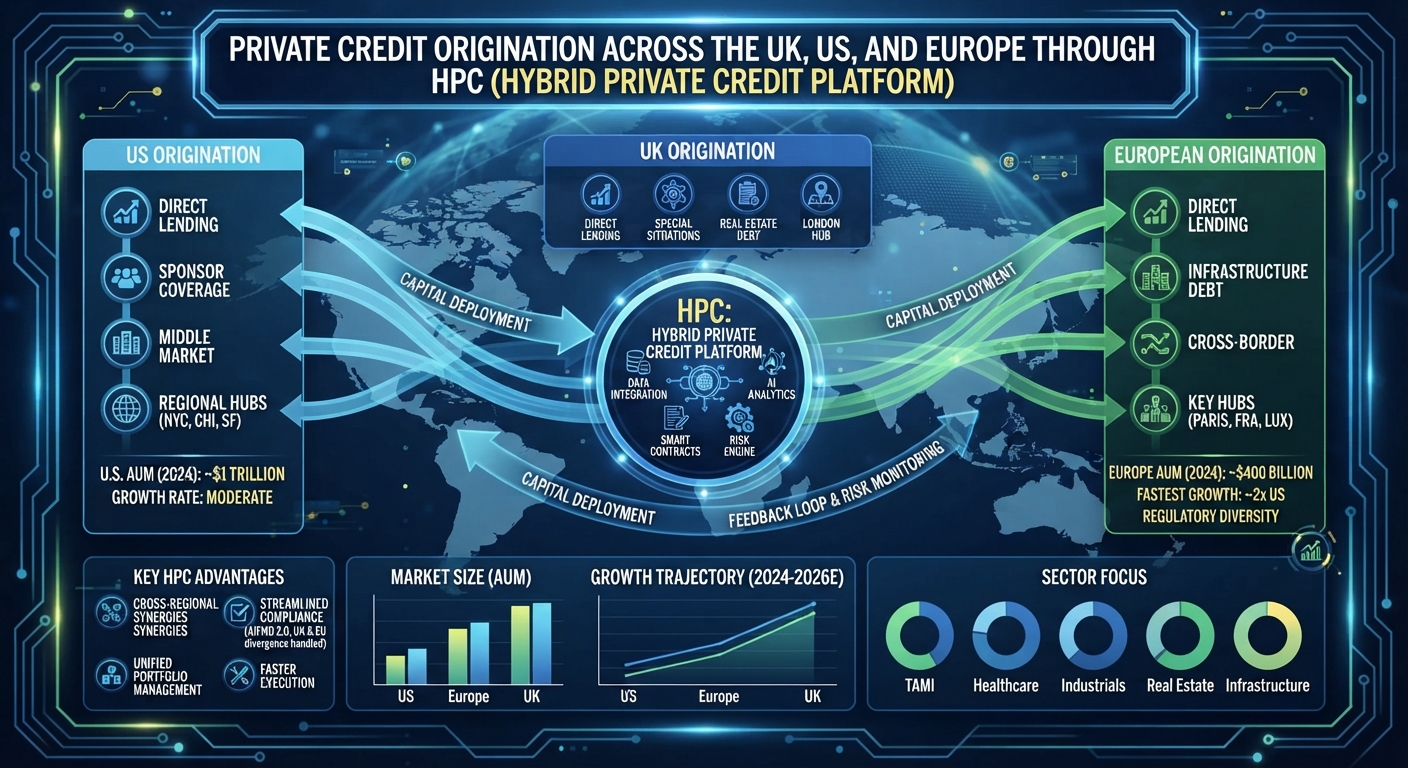
Institutional credit funds across the UK, US, and Europe are actively deploying capital into direct lending mandates, spot-purchase SME loan books, and non-performing loan (NPL) portfolios as banks manage balance-sheet constraints and middle-market borrowers seek flexible capital. While global private debt assets exceed $2.3 trillion and European private credit alone represents roughly $400 billion, institutional lenders face persistent competition to source quality mid-market borrowers outside crowded syndicated auctions.
Connecting mid-market borrowers and institutional lenders
HPC Consultancy Ltd (HPCCC) bridges this origination gap through its international network of local consultants, connecting established companies needing £5 million to £50 million in non-dilutive growth debt or balance-sheet restructuring with institutional direct lenders, special-situations funds, and portfolio acquirers.
-
For mid-market corporates and sponsors: Companies seeking £5 million to £50 million for working capital expansion, acquisitions, refinancing, or balance-sheet restructuring can approach HPCCC for confidential introductions to active UK, US, and European credit funds without giving up equity ownership.
-
For private credit funds and loan-book buyers: Direct lenders, distressed debt funds, and non-bank originators looking for bilateral £5 million to £50 million lending mandates, spot-purchase SME loan books, or NPL portfolios can partner with HPCCC to access vetted deal flow sourced by local consultants.
-
Origination alignment: HPCCC structures clear commercial agreements so local consultants and HPCCC earn an origination fee from the private credit lender upon facility drawdown or transaction completion.
Both sides invited to engage HPCCC
Whether you are a corporate borrower requiring £5 million to £50 million in structured debt or an institutional credit fund seeking off-market direct lending mandates and loan portfolios, contact HPCCC today to discuss your mandate under confidentiality.
Frequently asked questions for Slovakia investors on private credit origination and global markets
1. How does HPCCC originate £5 million to £50 million direct lending deals for institutional funds?
HPCCC works through its network of local consultants to identify established mid-market businesses needing £5 million to £50 million in non-dilutive growth capital or balance-sheet restructuring, introducing qualified borrowers directly to institutional private credit lenders.
2. How are origination fees structured when a private credit facility closes through HPCCC?
HPCCC puts a formal introducer and fee agreement in place with the private credit lender beforehand, earning an origination fee upon facility drawdown or completed loan-book acquisition.
3. Can both borrowers and private credit lenders contact HPCCC directly?
Yes, mid-market corporates seeking £5 million to £50 million in debt financing as well as institutional funds hunting for direct lending deals, spot-purchase SME loan books, and NPL portfolios can contact HPCCC to register their criteria.
4. Why are institutional funds across the UK, US, and Europe targeting spot-purchase SME loan books and NPL portfolios?
Bank balance-sheet optimisation and rising refinancing pressures create steady secondary flows of SME loan books and non-performing loans, allowing institutional buyers to acquire seasoned credit pools at attractive risk-adjusted yields.
5. How do London Stock Exchange AI infrastructure IPOs affect institutional capital allocation?
High-profile listings such as London Stock Exchange AI infrastructure IPOs following LIAN Group selecting London for its planned $500 million AI data centre listing highlight strong institutional appetite for digital infrastructure alongside private credit diversification.
6. What do UK capital markets listing reforms and exchange competition against European venues mean for international issuers?
UK capital markets listing reforms and exchange competition against European venues for international tech issuers aim to streamline public flotations while private credit fills mid-market growth funding gaps before IPO.
7. How do strategic corporate buyers competing with private equity sponsors on UK public-to-private takeovers drive debt demand?
Strategic corporate buyers competing with private equity sponsors on UK public-to-private (P2P) takeovers fuel demand for bespoke senior and unitranche acquisition debt facilities.
8. How do GP-led continuation vehicles, cross-fund transfers, and minority stake sales support private equity liquidity?
GP-led continuation vehicles, cross-fund transfers, and minority stake sales for private equity liquidity enable sponsors to extend ownership of top assets while returning cash to limited partners.
9. Why is UK withholding tax planning on private credit interest payments ahead of the proposed rise to 22% in April 2027 critical?
UK withholding tax planning on private credit interest payments ahead of the proposed rise to 22% in April 2027 helps cross-border credit funds and borrowers from Slovakia structure treaty relief, qualifying private placement exemptions, and net yield expectations early.
10. How do middle-market direct lending facilities supporting sponsor-backed continuation funds work?
Middle-market direct lending facilities supporting sponsor-backed continuation funds provide dedicated refinancing and add-on acquisition lines tailored to single-asset or multi-asset continuation vehicles.
11. How do UK National Wealth Fund co-investment mandates in defence technology and industrial manufacturing complement private credit?
UK National Wealth Fund co-investment mandates in defence technology and industrial manufacturing crowd in private institutional capital alongside senior debt facilities for UK industrial scale-ups.
12. How do bespoke retirement decumulation mandate design and pension risk transfer solutions influence UK credit demand?
Bespoke retirement decumulation mandate design and pension risk transfer (PRT) solutions sustain long-term insurer and pension demand for cash-flowing private credit assets.
13. Why are grid-connected battery storage, offshore wind, and data centre power interconnection assets attracting structured debt?
Grid-connected battery storage, offshore wind, and data centre power interconnection assets offer contracted infrastructure revenues suited to long-dated private credit and project finance facilities.
14. How do FCA operational resilience, cyber risk supervision, and semi-liquid wealth fund rules shape fund governance?
FCA operational resilience, cyber risk supervision, and semi-liquid wealth fund rules require asset managers and credit platforms to maintain robust risk controls, valuation governance, and liquidity management.
15. What does European defence and photonics M&A signal for industrial financing across Europe?
Major transactions in European defence and photonics M&A led by Thales entering exclusive negotiations to acquire a 51.6% controlling stake in Lumibird reflect accelerating strategic consolidation across European defence supply chains.
16. How do European infrastructure debt and equity fundraising closes expand capital availability?
Substantial commitments in European infrastructure debt and equity fundraising closes following F2i surpassing €1.2 billion across new infrastructure funds demonstrate deep institutional capital for European real assets.
17. How do European smaller-cap buyout fundraises and early-stage AI fintech venture fund resizing affect mid-market borrowers?
European smaller-cap buyout fundraises and early-stage AI fintech venture fund resizing leave many established mid-market companies seeking non-dilutive £5 million to £50 million debt facilities rather than equity dilution.
18. How does European large-cap strategic M&A resurgence influence corporate balance-sheet restructuring?
European large-cap strategic M&A resurgence and cross-border corporate acquisitions frequently generate non-core carve-outs and supply-chain borrowers requiring bespoke direct lending.
19. How do semi-liquid evergreen private credit vehicles and private credit CLO debt tranches broaden European credit markets?
Semi-liquid evergreen private credit vehicles targeting high-net-worth and European wealth channels alongside private credit collateralised loan obligation (CLO) debt tranches and senior secured middle-market loans expand funding capacity across Europe.
20. How do German industrial, defence, and technology infrastructure sovereign-backed acquisitions and EIC STEP Scale Up selections affect European growth?
German industrial, defence, and technology infrastructure sovereign-backed acquisitions and European Innovation Council (EIC) STEP Scale Up equity co-investment selections for deep-tech scale-ups strengthen European industrial ecosystems alongside private credit.
21. How do insurance broker consolidation and EU Foreign Subsidies Regulation filings affect cross-border transactions?
Insurance broker consolidation and capital-light managing general agent (MGA) platforms alongside cross-border M&A merger control and EU Foreign Subsidies Regulation filings shape deal structuring and regulatory clearance timelines across Europe.
22. What do Asian value-add real estate fundraises exceeding institutional targets indicate for regional capital?
Strong closes in Asian value-add real estate fundraises exceeding institutional targets highlighted by Invesco surpassing its $1.25 billion target for its Asian value-add real estate fund show continued institutional appetite for Asian real assets.
23. How do Indian impact and mid-market buyout fundraises support growing enterprises?
Momentum in Indian impact and mid-market buyout fundraises following Lok Capital's $130 million first close toward a $250 million target channels growth equity and credit into expanding Indian businesses.
24. How do South Korean eVTOL joint ventures and outbound Indian corporate M&A reflect Asian corporate expansion?
South Korean eVTOL operations, maintenance, and training ecosystem joint ventures alongside outbound Indian corporate M&A, cross-border IP protection, and global capability centre (GCC) structuring illustrate cross-border industrial and technology expansion across Asia.
25. How do the HKEX 60/40 index series, Indonesian sovereign wealth fund Danantara revisions, and Vietnam International Financial Centre expansion shape Asian finance?
The Hong Kong Exchanges and Clearing (HKEX) 60/40 index series blending Hong Kong equities with overseas assets, Indonesian sovereign wealth fund Danantara profit forecast revisions and state-backed asset restructuring, and Vietnam International Financial Centre expansion in Ho Chi Minh City and regional private market fund inflows reflect evolving Asian capital market architecture.
26. How do Taiwan's sovereign wealth fund preparations, Southeast Asian hyperscale AI data centres, and USD/JPY cross-currency basis swaps affect Asian allocators?
Taiwan legislative preparations for its inaugural sovereign wealth fund and domestic ETF expansion, hyperscale AI data centre equity raises and Southeast Asian power generation capacity, and foreign currency intervention thresholds and USD/JPY cross-currency basis swaps guide how investors from Slovakia manage regional allocations and currency hedging.
27. What do institutional African carbon credit fundraises signal for sustainable finance in Africa?
Progress in institutional African carbon credit fundraises led by Ardian nearing its €250 million target for its African carbon credits vehicle shows growing institutional capital entering African environmental markets.
28. How do critical mineral offtake agreements and multi-decade private port concessions support African supply chains?
Critical mineral offtake agreements, permitting milestones, and Final Investment Decisions (FID) for rutile, graphite, and rare earth projects alongside multi-decade private port and logistics terminal concessions tied to mineral supply-chain security underpin long-term project finance in Africa.
29. How do African data-centre M&A backed by Gulf sovereign wealth investors and AfCFTA alignment accelerate regional growth?
African data-centre and digital-infrastructure M&A backed by Gulf sovereign wealth investors and African Continental Free Trade Area (AfCFTA) regulatory alignment and national fintech consolidation support cross-border digital and financial integration.
30. How do African critical mineral platforms, African private credit facilities, pan-African fintech, sovereign eurobond spreads, and Mission 300 power finance expand debt opportunities?
African critical mineral investment platforms and debt-to-equity mining restructurings, African private credit facilities and larger-ticket institutional debt syndications, pan-African fintech, cross-border remittance infrastructure, and mobile money platforms, sovereign eurobond yield spreads and domestic local-currency treasury bill auctions, and utility-scale renewable energy, green hydrogen, and Mission 300 power project finance create diverse structured credit opportunities across the continent.
31. How does Saudi banking liquidity management influence regional corporate lending?
Saudi banking liquidity management, deposit growth vs credit expansion ratios, and domestic debt capital market deepening highlight how Gulf banks balance domestic loan growth with capital markets issuance.
32. How do Gulf sovereign wealth fund selective capital allocation and outbound European acquisitions shape global deal flow?
Gulf sovereign wealth fund selective capital allocation balancing domestic defence/stabilisation with strategic cross-border corridors alongside outbound Gulf sovereign wealth acquisitions in European industrial, defence, and AI infrastructure channels substantial institutional liquidity into international markets.
33. How do GCC debt advisory expansion and Gulf banking consolidation affect regional corporate finance?
GCC debt advisory expansion and non-dilutive financing amid a slower regional IPO pipeline together with Gulf banking consolidation and all-stock mergers expand structured debt options for regional corporates.
34. How do Gulf principal investments in UK/European data centres, Middle East fintech rounds, global sukuk liquidity, LNG offtake agreements, and master-planned urban land parcels diversify Gulf portfolios?
Gulf sovereign wealth principal investing in gigawatt-scale UK and European data centre joint ventures, Middle East fintech funding rounds across payments, data intelligence, and Islamic digital banking, global sukuk secondary-market liquidity and sovereign Islamic bond spreads, liquefied natural gas (LNG) long-term offtake agreements and petrochemical downstream assets, and master-planned urban development land parcels and hospitality brand management contracts demonstrate balanced deployment across credit, infrastructure, and real assets.
35. What do Australian regulatory enforcement priorities on private credit governance and Takeovers Panel rulings signal for fund managers?
Australian regulatory enforcement on private credit fund governance, valuations, and AFS licence suspensions following ASIC's latest funds update and 2027 enforcement priorities, alongside Australian Takeovers Panel rulings on undisclosed shareholder associations and corporate deal deliverability, underscore strict governance and valuation transparency across private funds.
36. How do US climate and energy transition fundraises and US agribusiness buyouts reflect North American private equity activity?
Major closes in US climate and energy transition private equity fundraises led by GEF Capital's $615 million first close and US agribusiness and animal health buyouts highlighted by Paine Schwartz's $315 million acquisition agreement show resilient North American sector-focused dealmaking.
37. How do Australian managed fund buy/sell spread adjustments and US critical mineral supply-chain security initiatives affect global markets?
Australian managed fund buy/sell spread adjustments and TMX Australia Exchange market-neutral regulatory consultations alongside US critical mineral supply-chain security, price floors, stockpiles, and sovereign offtake vehicles reflect evolving market liquidity rules and strategic supply-chain financing.
38. How do US direct lending spread compression, semi-liquid private credit distribution, PIPE transactions, and US Treasury yield hedging impact credit funds?
US direct lending spread compression, senior secured middle-market software loans, and healthcare non-accrual risk, semi-liquid private credit fund distribution across US retail and wealth management channels, private investment in public equity (PIPE) transactions and institutional growth capital allocations, and US Treasury long-dated yield hedging, Federal Reserve rate-path derivatives, and active fixed-income inflows shape global credit pricing and investor demand.
39. What types of mid-market corporates qualify for £5 million to £50 million facilities through HPCCC?
Established companies in the UK, US, or Europe with demonstrable cash flows, tangible asset backing, or contracted revenues seeking £5 million to £50 million for growth, acquisitions, or balance-sheet restructuring are well suited for HPCCC introductions.
40. Why do mid-market corporates choose private credit over equity dilution?
Non-dilutive growth debt allows founders and shareholders to fund expansion, acquisitions, or refinancing while retaining full equity ownership and operational control.
41. What is a spot-purchase SME loan book transaction?
In a spot-purchase SME loan book transaction, an institutional fund acquires an existing portfolio of small and medium-sized enterprise loans from a bank, fintech lender, or finance company for an upfront lump sum.
42. How do institutional buyers evaluate non-performing loan (NPL) portfolios?
NPL buyers analyse historical collection data, borrower collateral values, legal enforceability, and servicing recovery timelines to price distressed loan pools at a discount to face value.
43. How does HPCCC protect confidentiality for borrowers and loan-book sellers?
HPCCC executes mutual non-disclosure agreements before sharing company identities, financial models, or loan-tape data with shortlisted private credit lenders.
44. What information should a corporate borrower prepare before approaching HPCCC?
Borrowers seeking £5 million to £50 million should prepare historical financial statements, management accounts, cash-flow forecasts, existing debt schedules, and a clear summary of the funding purpose.
45. What mandate criteria should private credit funds share with HPCCC?
Institutional lenders and portfolio buyers should share target ticket sizes (£5 million to £50 million or portfolio minimums), geographic focus across the UK, US, or Europe, sector preferences, security requirements, and target yield thresholds.
46. How quickly can a £5 million to £50 million direct lending facility close once introduced?
Bilateral private credit facilities typically move from term sheet to drawdown within four to ten weeks depending on financial, legal, and collateral due diligence complexity.
47. Can HPCCC's local consultants source deals outside major financial capitals?
Yes, HPCCC's network of local consultants operates across regional commercial hubs in the UK, US, and Europe, uncovering off-market mid-market borrowers overlooked by city-based origination teams.
48. Does HPCCC charge upfront retainers to institutional lenders for origination?
HPCCC structures origination partnerships on a success-aligned basis, earning an agreed origination fee from the private credit lender upon facility drawdown or completed portfolio purchase.
49. Can investors from Slovakia co-invest alongside institutional direct lenders?
Family offices and institutional investors from Slovakia with direct credit mandates can register their ticket criteria with HPCCC to review bilateral lending or co-lending opportunities.
50. How can borrowers, loan-book sellers, or credit funds contact HPCCC today?
Both borrowers needing £5 million to £50 million and private credit funds seeking direct lending deals, SME loan books, or NPL portfolios can contact HPC Consultancy Ltd directly to outline their requirements and initiate confidential introductions.